


Marc Bolan / T. Rex (November 26, 1972) – “T. Rex Isn’t Capturing U.S.” Feature - The Home News

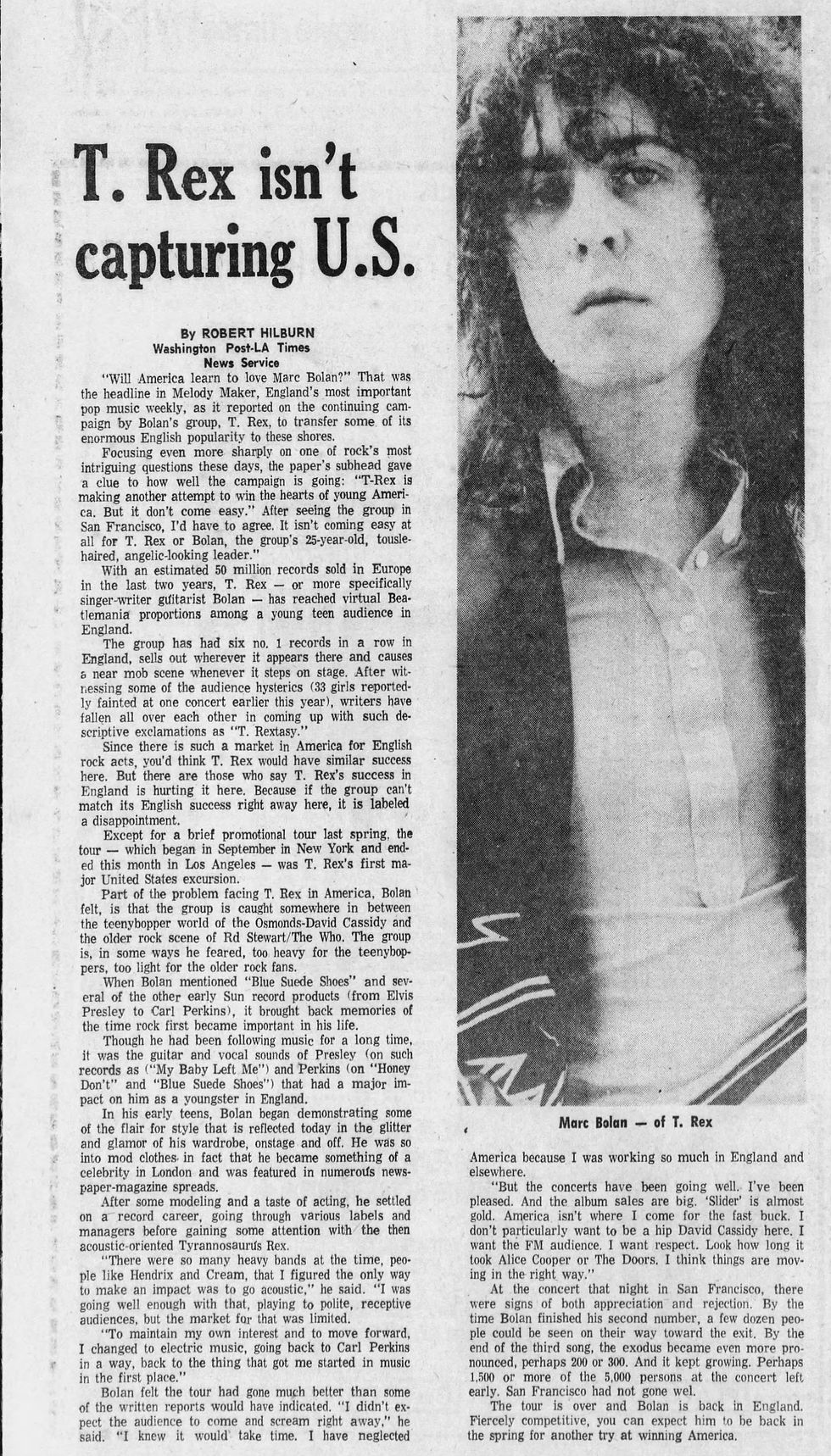
This substantial feature by Robert Hilburn examines Marc Bolan’s determination to establish T. Rex in the United States following the group’s first major American tour. Bolan discusses the difficulty of transferring his extraordinary British success to America, his musical roots, the changing T. Rex sound and his desire to earn respect without becoming what he calls a “hip David Cassidy".
Publication: The Home News
Date: November 26, 1972
Country: United States
Published under the headline “T. Rex isn’t capturing U.S.”, Robert Hilburn’s article begins with a question already being asked by the British music press: would America learn to love Marc Bolan?
The feature explains that T. Rex had already achieved extraordinary success in Britain and Europe. Bolan’s following among younger British listeners is compared with Beatlemania, while the group is credited with six consecutive No. 1 records in England and spectacular audience reactions at concerts.
America was proving more complicated. Apart from a brief promotional visit earlier in the year, the tour that began in New York in September and finished in Los Angeles was described as T. Rex’s first major United States excursion.
Bolan identifies one of the central difficulties himself. T. Rex occupied an awkward position between the teenage market represented by The Osmonds and David Cassidy and the older rock audience attracted to performers such as Rod Stewart and The Who.
Bolan considers the music too heavy for conventional teen-pop listeners, but potentially too light for established rock audiences.
The article then explores Bolan’s musical background. Records including “Blue Suede Shoes,” “My Baby Left Me” and “Honey Don’t” are identified as important early influences. Bolan explains that the sounds of Elvis Presley and Carl Perkins had a major impact on him while growing up in England.
His early career is also outlined, including modelling, acting and unsuccessful recording ventures before Tyrannosaurus Rex began attracting attention.
Bolan explains that the emergence of heavier groups, including Jimi Hendrix and Cream, led him to reconsider remaining completely acoustic. He believed an acoustic approach could work with receptive audiences but would ultimately restrict the size of his market. Moving towards electric music was therefore described as returning to the kind of music that first inspired him.
The feature reports that Bolan believed the American tour had gone considerably better than some written accounts suggested. He admits that he had underestimated how quickly American audiences would respond and acknowledges that spending so much time working in Britain and elsewhere had meant neglecting the United States.
Bolan says the concerts had ultimately pleased him and notes that The Slider was approaching gold status. Despite his desire for a larger American audience, he makes clear that he does not want to become purely a fashionable teenage attraction.
He states: “I don’t particularly want to be a hip David Cassidy here. I want the FM audience. I want respect.”
Bolan points towards artists including Alice Cooper and The Doors when explaining the kind of long-term career he admires, arguing that progress was moving in the right direction.
Hilburn closes by describing an improving audience response during a San Francisco concert. After initial signs of both appreciation and rejection, increasing numbers of people stood as the performance progressed. By the end, Bolan had begun to generate the kind of enthusiasm he had been seeking.
With the tour finished and Bolan back in England, the article predicts another American attempt the following spring.
CONTEXT AND NOTES
The feature provides a revealing contemporary assessment of the gap between T. Rex’s extraordinary British popularity and the group’s more difficult progress in America.
Rather than dismissing the problems, Bolan openly discusses the challenge of finding the correct audience. He refuses to position T. Rex entirely within either teen pop or conventional rock and instead emphasises his desire to build an audience that respected the music.
The article also places Bolan’s movement towards electric rock within the context of his earliest musical influences. His references to Elvis Presley and Carl Perkins demonstrate that he regarded the electric T. Rex sound as a return to his original musical interests rather than simply a commercial reinvention.
A large photograph dominates the clipping and is captioned “Marc Bolan - of T. Rex.”
FEATURE HIGHLIGHTS
Event: Robert Hilburn examines T. Rex’s progress in the American market
Era: 1972 American tour / Bolanmania era
Tone: Analytical, candid and career-focused
Photography: Large portrait photograph of Marc Bolan accompanying the feature
WHAT THE CLIPPING SHOWS
• Robert Hilburn assessing T. Rex’s attempts to establish major American success
• Comparison between Bolan’s enormous British following and his developing American audience
• Bolan discussing early influences including Elvis Presley and Carl Perkins
• Explanation of the transition from acoustic Tyrannosaurus Rex to electric T. Rex
• Bolan stating that he wanted respect rather than becoming “a hip David Cassidy”
• Reporting on the gradually improving audience response during the American tour
All magazine scans, photographs, and original text excerpts referenced in this entry remain the property of their respective copyright holders. This Chronicle entry is a transformative, non-commercial archival summary created for historical documentation and educational reference. No ownership of the original material is claimed or implied.


Comments