


T. Rex (February 12, 1971) – Hot Love b/w Woodland Rock / The King Of The Mountain Cometh Single: UK

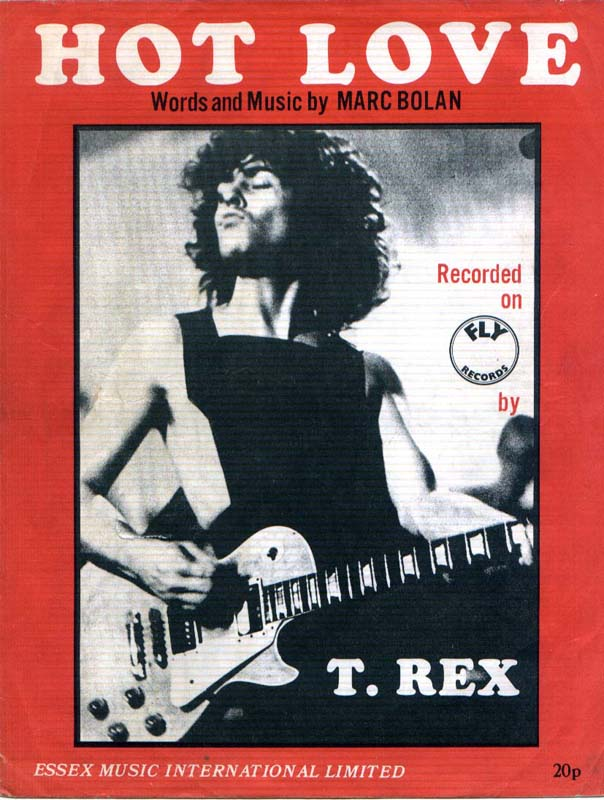
Released on February 12, 1971 through Fly Records, Hot Love became T. Rex's first UK number one single and the record that transformed Marc Bolan from a rising star into a national phenomenon. Following the success of Ride A White Swan, the single spent six weeks at the top of the UK Singles Chart and became one of the defining records of the early 1970s.

The release marked several important firsts in the group's history. It was the first T. Rex single to feature Steve Currie and Bill Legend, the first to feature Flo & Eddie as backing vocalists, and one of the key records that established the sound and image that would soon become known as glam rock.
Recorded at Trident Studios in Soho and produced by Tony Visconti, the release paired the hit title track with two exclusive B-side recordings, "Woodland Rock" and "The King Of The Mountain Cometh".
RECORDING
Recording sessions took place at Trident Studios, St. Anne's Court, Soho, London during January 1971, with additional overdubs completed later that month.
"Hot Love", "Woodland Rock" and "The King Of The Mountain Cometh" were recorded on the same 16-track tape. The release marked the first appearance of a full drum kit on a T. Rex recording, with Bill Fifield participating in the sessions before later adopting the name Bill Legend and joining the group permanently.
The release also introduced Flo & Eddie's backing vocals to a T. Rex single, adding an additional vocal dimension that would become a major feature of later recordings.

STYLE & THEMES
"Hot Love" represented a major step toward the highly commercial sound that would dominate T. Rex's most successful period. Combining acoustic guitars, electric instrumentation, layered backing vocals and a strong rhythmic groove, the record bridged the gap between the group's earlier folk-psychedelic roots and the glam rock explosion that followed.
TRACK-BY-TRACK NOTES
• Hot Love (4:53) — T. Rex's first UK number one single.
• Woodland Rock (2:25) — Exclusive B-side recording and one of the earliest tracks to feature Bill Legend's drumming.
• The King Of The Mountain Cometh (3:57) — Originally begun during sessions for the T. Rex album and the only recording released featuring the Bolan, Finn and Currie trio.

RELEASE HISTORY
The single was released on February 12, 1971 by Fly Records.
Following two performances on Top Of The Pops during March 1971, Marc Bolan's appearance in satin clothing and glitter make-up became one of the defining visual moments associated with the birth of glam rock.
The single became T. Rex's first chart-topper, spending six consecutive weeks at number one in the UK.
Internationally it reached the charts in numerous countries including Australia, New Zealand, Canada, South Africa and the United States.
NOTES
• First UK number one single by T. Rex.
• Remained at No. 1 for six weeks.
• First single to feature Steve Currie and Bill Legend.
• First major T. Rex release to feature Flo & Eddie backing vocals.
• The performances on Top Of The Pops during March 1971 are widely regarded as a landmark moment in the emergence of glam rock.
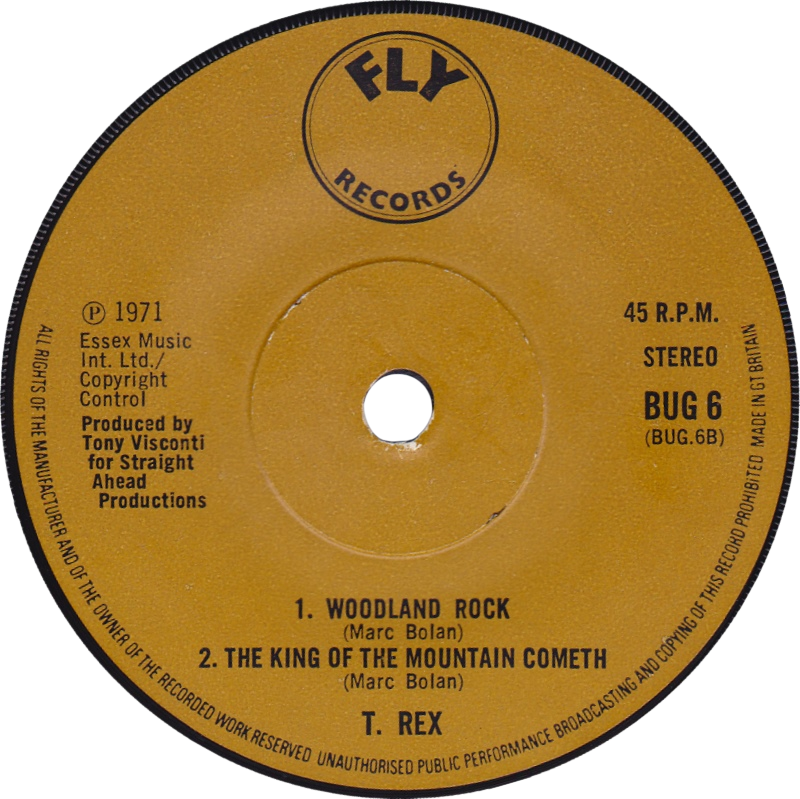
• The first commercial copies were issued on mustard-coloured Fly Records labels.
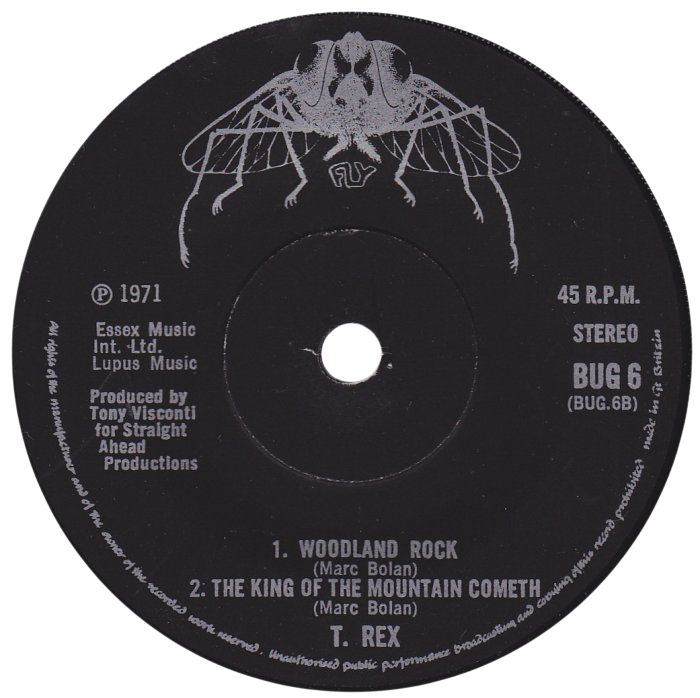
• Later pressings switched to the Roger Dean-designed black label featuring the white/silver fly logo.
• Eighteen recognised UK label variants exist.
• Multiple test pressings, mispressings and label errors have become highly collectible among T. Rex collectors.
• "Woodland Rock" and "The King Of The Mountain Cometh" remained exclusive non-album B-sides.
• "The King Of The Mountain Cometh" is the only officially released recording featuring the Bolan, Finn and Currie line-up without Bill Legend.
• The single established T. Rex as Britain's biggest pop act of 1971 and paved the way for the success of "Get It On", "Telegram Sam" and "Metal Guru".
CHARTS
Territory | Peak Position |
UK | 1 |
Australia | 4 |
New Zealand | 7 |
South Africa | 12 |
Canada | 47 |
US Billboard Hot 100 | 72 |
US Cash Box | 54 |
PERSONNEL
Marc Bolan — lead vocals, guitar
Steve Currie — bass guitar
Mickey Finn — handclaps
Bill Legend (Bill Fifield) — drums
Tony Visconti — string arrangement, producer
Howard Kaylan — backing vocals
Mark Volman — backing vocals
PRODUCTION
Recorded: January 21-22, 1971
Studio: Trident Studios, London
Producer: Tony Visconti
Label: Fly Records
TRACKLIST TABLE UK
Format | Tracklisting |
UK 7" Single | Side 1: Hot Love (4:53) Side 2a: Woodland Rock (2:25) Side 2b: The King Of The Mountain Cometh (3:57) |
UK VARIANTS TABLE (UK)
Variant | Description |
1 | Mustard label, solid centre, no forward slash after "Ltd." on either side |
2 | Mustard label, solid centre, forward slash after "Ltd." on side 2 only |
3 | Mustard label, solid centre, forward slash after "Ltd." on side 1 only |
4 | Mustard label, solid centre, forward slash on both sides |
5 | Mustard label, push-out centre, no forward slash on either side |
6 | Mustard label, push-out centre, forward slash after "Ltd." on side 2 only |
7 | Mustard label, push-out centre, forward slash on both sides |
8 | Mustard jukebox centre, forward slash after "Ltd." on side 2 only |
9 | Mustard jukebox centre, forward slash on both sides |
10 | Black label, solid centre, "Lupus Music" on side 2 instead of "Copyright Control" |
11 | Black label, solid centre, no forward slash on either side |
12 | Black label, solid centre, forward slash after "Ltd." on side 2 only |
13 | Black label, jukebox centre, no forward slash on either side |
14 | Black label, jukebox centre, forward slash after "Ltd." on side 2 only |
15 | Black label, jukebox centre, "Lupus Music" on side 2 |
16 | Black label, push-out centre, "Lupus Music" on side 2 |
17 | Black label, push-out centre, no forward slash on either side |
18 | Black label, push-out centre, forward slash after "Ltd." on side 2 only |
TEST PRESSINGS & MISPRESSINGS
Variant | Notes |
White Label Test Pressing | Genuine copies exist, although many counterfeits have appeared on the collectors' market |
Solid Centre Test Pressing | Example known to have belonged to BBC Radio Bristol DJ Roger Bennett |
Double A-Side Label Error (Solid Centre) | Both sides carry the A-side label |
Double A-Side Label Error (Push-Out Centre) | Both sides carry the A-side label |
Misaligned Label Variant | Known example exists with labels incorrectly positioned |
"5A" Mustard Label Test Pressing | Later confirmed to be a fake created from a standard Hot Love pressing with added labels |
INTERNATIONAL VARIANTS (EXCLUDING UK)
Country | Label | Catalogue Number | Format / Notes | Year |
Argentina | Odeon Pops | DTOA/M-5102 | 7", 45 RPM | 1971 |
Australia | Parlophone | A-9443 | 7" Single | 1971 |
Australia | Parlophone | A-9443 | 7", Promo | 1971 |
Austria | Ariola | 14 896 AT | 7", 45 RPM Single | 1971 |
Belgium | Stateside | 4C 006-92387 M | 7", 45 RPM, Mono | 1971 |
Brazil | Odeon | 71-3294 | 7", 33⅓ RPM, Misprint | 1971 |
Brazil | Odeon | BUG-6 / 71-3294 | 7", 33⅓ RPM | 1971 |
Canada | Reprise Records | REP 1006 | 7" Single | 1971 |
Denmark | Stateside | 6E 006 92387 | 7" Single | 1971 |
Denmark | Stateside | 6E 006-92387 | 7" Single | 1971 |
France | CBS | CBS 7113 | 7", 45 RPM Single | 1971 |
Germany | Ariola | 14 896 AT | 7", Stereo | 1971 |
Germany | Ariola | 14 896 AT | 7", Stereo Variant | 1971 |
Germany | Not On Label | Nr.14896 | 7", Promo | 1971 |
Greece | Columbia | SCMG 483 | 7", 45 RPM Single | 1971 |
Greece | Columbia | SCMG 483 | 7", Multicolour Variant | 1971 |
India | Stateside | ESS.158 | 7", 45 RPM Single | 1971 |
Ireland | Fly Records | BUG 6 | 7", 45 RPM Single | 1971 |
Ireland | Fly Records | BUG 6 | Variant | 1971 |
Japan | Odeon | OR-2787 | 7", 45 RPM Single | 1971 |
Japan | Odeon | OR-2787 | 7", Stereo | 1971 |
Japan | Odeon | OR-2787 | 7", Promo | 1971 |
Lebanon | Parlophone | MOL 51 | 7", 45 RPM | 1971 |
Netherlands | Stateside | 5C 006-92387 | 7", Stereo | 1971 |
New Zealand | Parlophone | NZP 3401 | 7" Single | 1971 |
Nicaragua | Odeon | 01-0585 | 7", 45 RPM | 1971 |
Norway | Stateside | 7E 006-92387 | 7", 45 RPM Single | 1971 |
Norway | Stateside | 7E 006-92387 | Variant | 1971 |
Portugal | Fama / Zip Zip | FMZ 32001/S | 7", 45 RPM Single | 1971 |
Singapore / Malaysia / Hong Kong | Columbia | EAC-1052 | 7", 45 RPM | 1971 |
South Africa | Parlophone | SPD 549 | 7", 45 RPM EP | 1971 |
Spain | Ariola | 14935-A | 7", Mono | 1971 |
Sweden | Stateside | 4E 006-92387 M | 7" – Hot Love / Woodland Rock / The King Of The Mountain Cometh | 1971 |
Sweden | Stateside | 4E 006-92387 M | 7" – Hot Love / The King Of The Mountain Cometh | 1971 |
Turkey | Stateside | TSS 4086 | 7", 45 RPM | 1971 |
USA | Reprise Records | 1006 | 7", 45 RPM Single | 1971 |
USA | Reprise Records | 1006 | Label Variant | 1971 |
USA | Reprise Records | 1006 | Promo | 1971 |
USA | Reprise Records | REP 1170 | 7" Single | 1973 |
USA | Reprise Records | REP 1170 | Promo | 1973 |
Venezuela | Reprise Records | REP 1006 | 7", 45 RPM Single | 1971 |
Venezuela | Reprise Records | REP 1006 | Promo | 1971 |
SOURCES Discogs, 45 Worlds, Wikipedia, BBC Official Charts, Demon Records, Rockfiles, Official Marc Bolan archives, All album artwork, photographs, labels, and original text excerpts remain the property of their respective copyright holders. This entry is a transformative, non-commercial archival summary created for historical documentation and educational reference.


Comments