


T. Rex (October 26, 1972) – “T. Rex Album Exhibits Marc Bolan Image Trip” The Slider Album Review - The Journal News

This sharply critical Journal News review by John Terhar examines The Slider through the increasingly dominant image of Marc Bolan. While acknowledging Bolan’s carefully constructed style and the album’s consistency with contemporary musical fashion, Terhar dismisses much of the music as marginal, attacks the sexual imagery and lyrical simplicity, and argues that the record ultimately represents an extended Marc Bolan “image trip.”
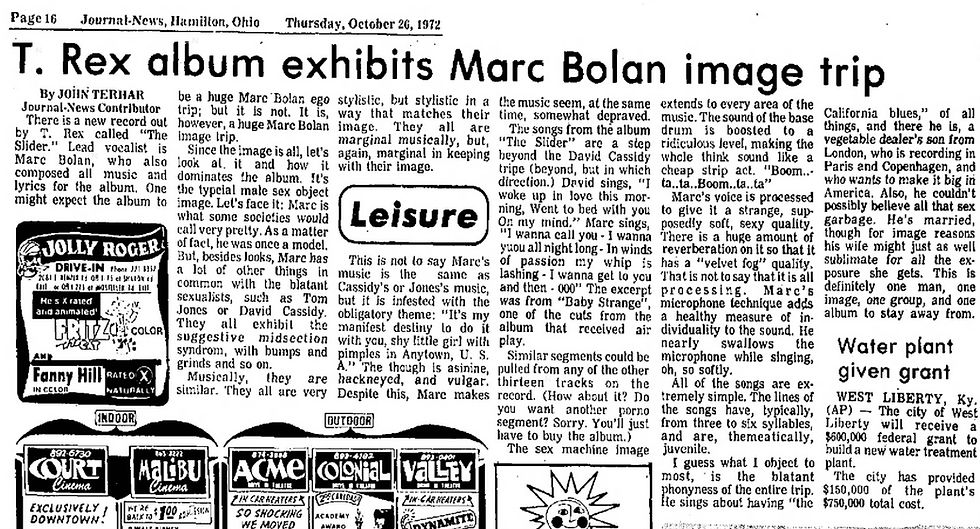
Publication: The Journal News
Date: October 26, 1972
Country: United States
Writer: John Terhar
THE STORY
Published under the headline “T. Rex album exhibits Marc Bolan image trip”, the review opens by identifying The Slider as the new T. Rex album and Marc Bolan as the principal creative force behind it.
Terhar notes that Bolan composed the album’s music and lyrics and suggests that this might lead listeners to expect the record to be dominated by Bolan’s personality.
The reviewer concludes that this is indeed the case, describing The Slider as a “huge Marc Bolan image trip.”
Rather than considering image a secondary element, Terhar makes it the central theme of the review.
THE MARC BOLAN IMAGE
The article discusses Bolan’s appearance and previous work as a model before drawing comparisons with other contemporary performers.
Terhar places Bolan alongside Tom Jones and David Cassidy, arguing that all project deliberately sexualised public images.
The reviewer contends that this visual and sexual presentation extends directly into Bolan’s music and lyrics.
Despite this criticism, Terhar acknowledges that Bolan is stylistically attuned to the period, describing the overall approach as matching contemporary fashion even when the reviewer finds the music itself less substantial.
THE MUSIC
Musically, the review is distinctly negative.
Terhar describes the material as “marginal”, although the writer accepts that its style remains consistent with Bolan’s image.
A section of “Baby Strange” is reproduced within the review as an example of what Terhar considers the album’s overt sexual content.
The reviewer says similar passages could be selected from the other tracks and jokes that readers wanting further examples would have to buy the album.
The bass drum is criticised for being pushed to an excessive level, with its repeated sound mockingly rendered as:
“Boom...ta...Boom...ta..ta”
Bolan’s voice also receives detailed attention. Terhar describes the vocal sound as processed to produce a soft and unusual quality, with considerable reverberation contributing what the reviewer calls a “velvet fog” effect.
The article does, however, recognise Bolan’s microphone technique as contributing to the individuality of the sound.
THE LYRICS
Terhar argues that the songs themselves are extremely simple.
The lyrical lines are described as typically containing only a small number of syllables and as being thematically juvenile.
What most troubles the reviewer is the sexual emphasis running throughout the record. Terhar sees this as further evidence that the musical content and Marc Bolan’s public image are inseparable.
The reviewer references “Telegram Sam” and “Baby Strange” while assessing this aspect of the album.
AN IMAGE-DRIVEN ALBUM
The article ultimately presents The Slider as a record dominated by one individual.
Bolan is portrayed as songwriter, vocalist, image-maker and central personality, with the reviewer arguing that virtually every element of the album reinforces the same carefully cultivated persona.
Terhar closes by describing the project as:
“definitely one man, one image, one group, and one album to stay away from.”
It is an exceptionally negative conclusion, but one that provides a revealing example of the resistance Bolan and T. Rex sometimes encountered from sections of the American press during 1972.
CONTEXT AND NOTES
The review is valuable to the T. Rex archive precisely because it is so critical.
Rather than presenting The Slider retrospectively as an established glam-rock album, the article captures one American writer’s immediate response to Bolan’s music, image, sexuality and production style during 1972.
Terhar clearly recognises that Bolan’s visual presentation and recording style form a coherent identity, even though the critic strongly dislikes the results.
Preserving reviews such as this alongside more favourable contemporary assessments provides a more honest picture of how T. Rex were received during the period.
FEATURE HIGHLIGHTS
Event: Review of The Slider
Publication Date: October 26, 1972
Era: The Slider era
Tone: Highly critical
Writer: John Terhar
Photography: No artist photograph accompanies the supplied clipping; the article is presented principally as a text review
WHAT THE CLIPPING SHOWS
• John Terhar reviewing T. Rex’s The Slider
• Marc Bolan described as the dominant creative and visual force behind the album
• Comparisons with Tom Jones and David Cassidy
• “Baby Strange” used as an example of the album’s lyrical approach
• Criticism of the prominent bass-drum sound
• Discussion of Bolan’s processed vocal sound and microphone technique
• The reviewer describing the vocal effect as possessing a “velvet fog” quality
• Strong criticism of the album’s sexual imagery and simple lyrics
• An emphatically negative final verdict on the record
All magazine scans, photographs, and original text excerpts referenced in this entry remain the property of their respective copyright holders. This Chronicle entry is a transformative, non-commercial archival summary created for historical documentation and educational reference. No ownership of the original material is claimed or implied.


Comments