


T. Rex (October 23, 1971) – “Marc Bolan” Feature & Free Colour Poster - Sounds

This October 23, 1971 issue of Sounds gives Marc Bolan particularly prominent coverage during the extraordinary rise of T. Rex. A free full-colour concert poster was advertised across the top of the front page, while an extensive interior feature examined Bolan’s increasing fame, his attitude towards success, his relationship with audiences and the pressures accompanying his new position as one of Britain’s biggest rock stars.

Publication: Sounds
Date: October 23, 1971
Country: United Kingdom
COVER
The front page prominently announces:
“FREE INSIDE MARC BOLAN COLOUR POSTER”
Although the principal front-page story concerns Crosby, Stills, Nash & Young, the Marc Bolan poster is given the full width of the page above the Sounds masthead, making the T. Rex feature one of the issue’s strongest promotional attractions.
The issue is dated October 23, 1971 and priced at 6p.
Other artists promoted on the cover include Leonard Cohen, Maggie Bell, Rory Gallagher, Miles Davis and the Incredible String Band.
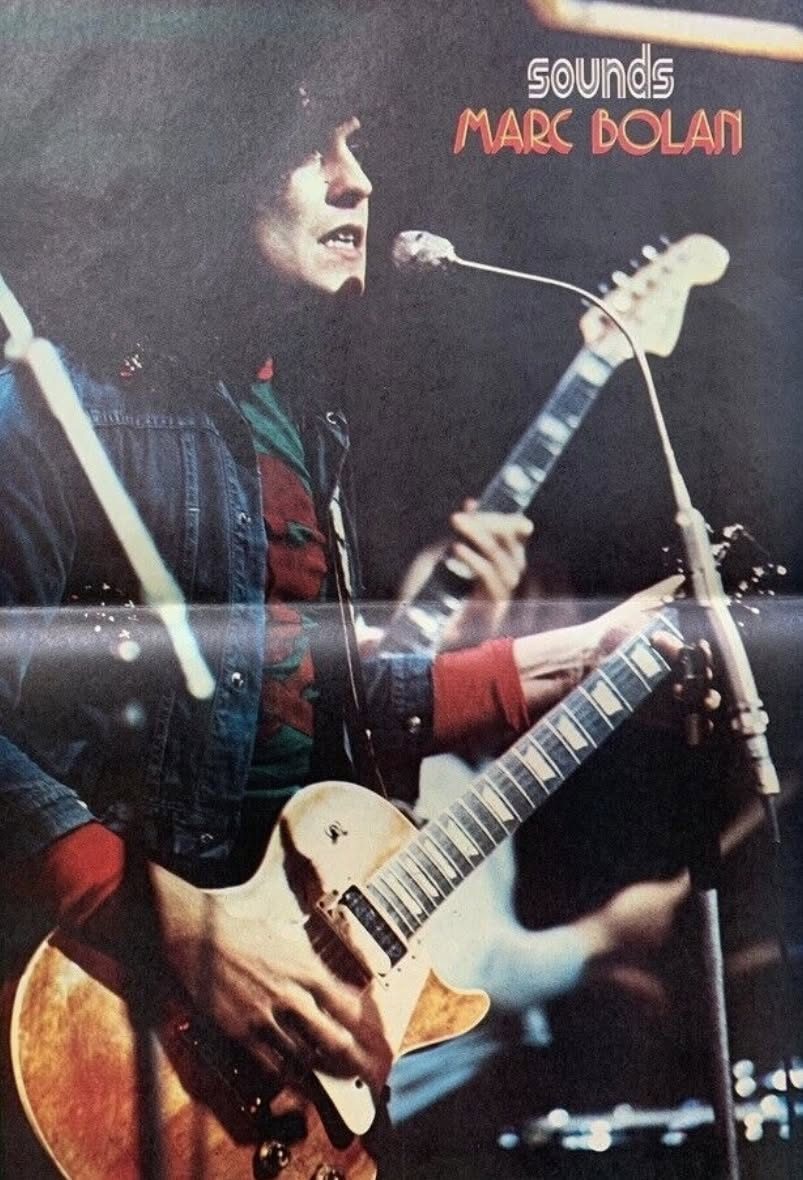
THE COLOUR POSTER
The free centre-page poster features a large colour performance photograph connected with Marc Bolan and T. Rex.
The image captures two guitarists performing together on stage, with a gold-coloured Les Paul-style electric guitar dominating the foreground and another lighter-coloured guitar visible behind.
The poster carries the Sounds logo together with the large caption:
“MARC BOLAN”
The dark concert background, strong stage lighting and red-and-green clothing give the poster a vivid visual character, making it clearly intended as a removable fan collectable rather than an editorial page.
THE STORY
The substantial feature on page 10 is headed simply “MARC BOLAN” and opens by considering the demands that accompany life as a successful rock performer.
The article notes the constant pressures surrounding Bolan, including changing clothes, recording, putting together lyrics, conducting interviews and dealing with the continual demands generated by his rapidly expanding fame.
At the same time, the writer describes a contrasting private figure who could retreat from the public activity surrounding T. Rex.
Particular attention is given to the extraordinary events of 1971, which the article describes as the year when everything happened for T. Rex.
The feature charts the extraordinary rise from a relatively specialised following to enormous commercial popularity. It states that within a nine-month period T. Rex had produced several major records and sold millions of copies.
Rather than simply celebrating the success, however, the article examines what that level of attention meant to Bolan personally.
SUCCESS AND IMAGE
Bolan discusses accusations that success had altered T. Rex or that the group had deliberately moved towards a more commercial sound.
He rejects the idea that the music had been cynically changed to reach a larger audience. Instead, the feature presents the development as something that happened naturally as Bolan’s interests and approach evolved.
The article also addresses the image surrounding Bolan. By this point his appearance and personality had become subjects almost as widely discussed as the records themselves.
Bolan talks about the importance of communicating with an audience and suggests that music provides a particularly powerful means of doing so.
The feature distinguishes between image and the music itself, presenting Bolan as aware of the visual character surrounding T. Rex but unwilling to treat image as the sole reason for the group’s success.
THE MUSIC
The article discusses the way T. Rex had developed musically while retaining an immediately recognisable identity.
Bolan addresses the move towards amplified rock and rejects suggestions that using electric instruments represented an abandonment of his earlier musical approach.

The enormous success of the records had dramatically increased the size of the audience, but Bolan argues that artistic development should not automatically be interpreted as commercial calculation.
At the time of publication, T. Rex were firmly within the Electric Warrior period. The album had brought together the fuller electric sound that had developed across the preceding singles while establishing the musical identity that now accompanied the group’s rapidly increasing popularity.
FAME AND THE FUTURE
The feature also finds Bolan looking ahead.
Despite the extraordinary acceleration in his career, he talks about continuing to write and record rather than treating current success as an end point.
One passage considers whether success itself might eventually become limiting. Bolan acknowledges the possibility that audiences can move on and that no period of popularity lasts indefinitely.
Yet the overall impression is of an artist determined to maintain creative momentum rather than simply repeat whatever had already worked.
The article therefore captures an especially interesting point in T. Rex history: Marc Bolan had reached enormous commercial success, but the scale of Bolanmania was still developing.
CONTEXT AND NOTES
Published during the autumn of 1971, this issue of Sounds provides both an extended written portrait of Marc Bolan and a large colour T. Rex collectable.
The combination is particularly representative of how quickly T. Rex had moved beyond conventional music-paper coverage. Bolan was now sufficiently popular for Sounds to use a free colour poster as one of the primary selling points of the entire issue.
The accompanying article is also valuable because it does not simply celebrate chart success. It considers fame, artistic change, audience communication, image and the difficulties associated with becoming a major rock personality.
Together, the feature and poster provide a strong contemporary snapshot of T. Rex at the point where their success was developing into the phenomenon that became known as Bolanmania.
FEATURE HIGHLIGHTS
Event: Major Marc Bolan feature with free T. Rex colour poster
Era: 1971 Electric Warrior era
Tone: Reflective, analytical and fan-focused
Cover: “Free Inside Marc Bolan Colour Poster”
Poster: Full-colour live T. Rex concert image
Feature: Full-page interview/profile headed “Marc Bolan”
WHAT THE CLIPPING SHOWS
• Sounds dated October 23, 1971
• Cover promotion for a free Marc Bolan colour poster
• Full-colour centre-page T. Rex performance poster
• Extensive page 10 feature devoted to Marc Bolan
• Discussion of T. Rex’s extraordinary success during 1971
• Bolan responding to questions surrounding commercial success and artistic change
• Discussion of image, communication and the relationship between performer and audience
• Contemporary coverage from the Electric Warrior period as Bolanmania continued to gro
All magazine scans, photographs, and original text excerpts referenced in this entry remain the property of their respective copyright holders. This Chronicle entry is a transformative, non-commercial archival summary created for historical documentation and educational reference. No ownership of the original material is claimed or implied.


Comments